This article was originally published in NATE’s (National Association for the Teaching of English) publication Teaching English: Issue 27.
‘All I could discern distinctly by the moonlight was a colourless, youthful face, meagre and sharp to look at about the cheeks and chin; large, grave, wistfully attentive eyes; nervous, uncertain lips; and light hair of a pale, brownish-yellow hue.’
This extract, from Wilkie Collins’ The Woman in White, proved to be a source of some confusion when it was included in an English Language mock exam in November 2017, and subsequently prompted much discussion and head-scratching amongst English colleagues. Having been provided with a longer extract, and a glossary of terms which defined ‘meagre’ as ‘thin and undernourished’, students were asked to explain how language and structure had been used by the writer to convey the narrator’s thoughts and feelings. Many students were able to identify that the ‘suspiciously late hour […] in that suspiciously lonely place’, coupled with the sudden appearance of a ‘nervous’ and ‘grave’ ethereal figure, would be the cause of some consternation – even alarm – for the narrator.
However, a notable number of students read the narrator’s emotions quite differently. For them, there was something quintessentially romantic about this couple, meeting unexpectedly after midnight at a crossroads. The slim figure of a woman, seemingly adorned in matrimonial white, and a man, stunned by her appearance, drinking in every detail of her face, had all the ingredients of a lovers’ tryst. What had led these students to such a misconception? What had caused them to interpret her thin form as beautiful, his confusion as attraction, and, most pressingly, what had led them to overlook the Gothic iconography with which this scene is laden?
The elephant in the text
These were questions discussed by English colleagues in the ensuing weeks, and the conclusion to which we were drawn was that, crucially, not all students had understood the genre with which they had been presented, and therefore, did not have the tools to accurately make sense of it. In fact, this was no new encounter for us, nor was it isolated to the exam setting or reading analysis. Many teachers will recognise the phenomenon of the sudden and unwelcome appearance of a mobile phone at the climactic moment of a student’s haunted house mystery, or the comparison of a mythological protagonist to an aeroplane/a Ferrari/a bullet [insert example, as (in)appropriate]. What is missing from these examples is students’ secure knowledge of the conventions which underpin different literary genres.
What was to be done about this? How could we equip learners with a necessary knowledge of literary genres, early in their secondary education, which would enable them to be empowered readers and writers? How could we make this a creative, enriching and critically-engaging experience, rather than a process motivated by ‘exam-readiness’?
‘Intellectual Velcro’
‘The more things we know, the more detail we possess, the more links and connections we can make. Seeing these links is insight; making these connections is creative. What you know is like intellectual Velcro; new stuff sticks to it, so, the more you know, the more you learn. The more you learn, the more you are.’
As David Didau seems to suggest in this observation (2017), critical and creative thinking is born out of knowledge, not separate from it. This was the thought which prompted our rethinking about how we taught literary genre within our KS3 curricula, and which has resulted in the creation of a programme of study which explicitly and implicitly fosters this knowledge.
It’s important to explain that in using the term ‘literary genre’, we refer to types of narrative such as horror, fantasy, crime and detective etc. rather than literary forms. By building students’ knowledge of literary genres, and their conventions, we intend to help them make connections between their knowledge and the new texts they read and, indeed, create.
Revisiting literary genre and continuing to make these connections through a spiral curriculum enables students to repeatedly draw on their existing knowledge, and thereby build upon and broaden it. Thus, the more connections they make, the more empowered they become as readers and writers.
Herein is our aim: to equip students with a knowledge of ‘generic codes’ – symbols or signposts of a genre which act as points of reference by which they can make sense of new texts, limit the scope of misconception and, ultimately, make informed decisions about what they read beyond the classroom (Bawarshi, 2003). Learners who can recognise these ‘generic codes’ have the tools to make connections; they have the knowledge to form predictions about books (as well as the responses they may evoke), and to make decisions about which ones they will choose to read (Bawarshi, 2003). However, the dilemma presented by reimagining the curriculum in this way is how to teach the conventions of literary genre without reducing them to a series of formulae for decoding an unseen extract, thus compromising understanding of nuance and design in the crafting of the text.
Reading beyond the classroom
Of course, we understand the need to prepare our learners to tackle unseen texts in an exam setting, but we also acknowledge that they will be more able to do so if they are readers beyond the classroom. Learners who possess an ‘expanded view of genre are able to account more fully for what writers do when they write, why they do it and what happens to them as readers when they encounter such texts, since they have greater understanding of the writing as a construct’ (Bawarshi, 2003). This insight into the relationship between writer, text and reader is valuable in the context of all reading experiences, not just academic ones.
For us, it is important that we do this now, given the decline in recreational reading among young people; the National Literacy Trust’s Annual Survey for 2019 states that 35.2% of students aged 11–14 ‘cannot find things to read that interest [them]’, and this figure increases to 39.9% for students aged 14–16 (Clark and Teravainen-Goff, 2020). While we cannot claim that teaching literary genre will alone result in all students reading for pleasure, we do believe that using knowledge of literary genre to understand what we like to read is an important step in perceiving ourselves as readers and in forming a reading identity. What we choose to read reveals a lot about us and our relationship with the world, much like many of the other choices we make – the music to which we listen, the clothes we wear, the types of cuisine we eat.
Creating literary gourmands
Indeed, the analogy of food has offered us a useful metaphor for understanding this process. Imagine a diner in a restaurant, familiar with the cuisine, and thus the menu from which they are making their choice. Their knowledge of the flavour palate and prior experience of this cuisine enables them to make an informed decision about a dish they will enjoy, much like a reader who understands which genres they prefer and can choose a text accordingly. The diner’s confidence with the menu may even encourage them to choose an item which they have not tried before.
However, for a diner who is unfamiliar with the cuisine, making a choice may seem overwhelming and fraught with unpalatable risk. It could even seem easier not to make a choice at all. Such a scenario may be familiar to teachers who have attempted to help their students choose a reading book during the allotted library lesson, and whose question of ‘What types of books do you like?’ is met with a bewildered, or even indifferent, shrug.
Our hope is to move students away from such shrugs and more towards becoming literary ‘gourmands’. To achieve this, we have adopted some of the following strategies within our curricula.
The expert in the room
As with all effective schemes of learning, subject knowledge is integral to the successful teaching of literary genre, thus investing in teachers’ expertise should be the starting point. The British Library is just one source that provides a wealth of rich and reliable resources that enable teachers to learn the origin of different genres, as well as their evolution over time, from original archetypes to more modern incarnations.
Equally, this is an opportunity to draw upon the existing expertise and interests of the department: who is a secret sleuth, a lover of the macabre, a ‘thought criminal’? Choose genres which enable teachers to impart knowledge from their own reading, and thus facilitate a truly collaborative scheme of learning.
After all, teachers’ acknowledgement of themselves as readers, with particular preferences, expectations and opinions about different genres, is fundamental when role-modelling the habits of a reader. This is also an opportunity to tap into students’ interests by selecting genres based on their prior reading experiences, thereby building their confidence as they make the transition from familiar to unfamiliar genres.
Texts across time and mode
Choosing genres and texts to explore with our students presents an opportunity to select diverse writing which has popular appeal, will pique their interests, and will offer them cultural knowledge. From experience, we have learnt that the genres which serve these purposes for our students are horror, crime and detective, dystopia, and fantasy.
In order to foster learners’ understanding of the common conventions of these genres, we explicitly explore the recurring symbols of such narratives; we unpick the similarities between character types, settings, events and themes so that students can begin to recognise patterns across texts of the same genre, understand the purpose and significance of these elements within the narratives, and use their knowledge to make predictions about new texts. Such an explicit exploration allows us to draw parallels between a range of texts, be they classics or contemporary, aimed at children, young adults or adults, written or multi-modal. When studying the horror genre, for example, our students work closely with extracts from Dracula, ‘The Birds’, The Haunting of Hill House, The Woman in Black, Coraline and Don’t Ask Jack, as well as clips from the film The Others.
Reflecting on genre
By selecting a timeline of texts, we support students to reflect critically on each genre, exploring why different styles emerged at specific moments in time and how they are shaped by their socio-historical context. They also evaluate how conventions have evolved over time, and probe why such narratives have an enduring appeal.
Most importantly, students learn to reflect on their own tastes by discussing which texts they would read further and why. The use of non-fiction articles which, for instance, discuss the appetite for dystopia amongst young adults, or the appeal of crime and detective fiction across cultures, create further avenues for exploring and questioning reader preferences on a broader scale.
Crucially, such critical reflection creates space for us to undo narrow perceptions of genre – the dreaded ‘formula’ to which we alluded earlier. Any exploration of a breadth of texts necessarily prompts the question ‘How is this text different?’.
A good example to illustrate this is Daphne du Maurier’s ‘The Birds’. Whilst considered a horror story, du Maurier deviates from the supernatural threat and replaces it with one which is conventionally benign, which provokes several questions: Why does she do this? What is the risk? How do we, as readers, feel about this deviation? Thus, students learn that writing within a genre is more nuanced than simply following a formula, and whilst the conventions of a genre offer a framework, writers (our students included) can and should take risks within that.
The knowledge garnered through this explicit teaching of genre serves as a foundation for subsequent text studies, helping learners contextualise the new literature that they encounter. Our students’ learning of the horror and crime genres offers a way into their later reading of The Hound of the Baskervilles, but is also enriched as they explore Gothic as a distinct branch of horror.
Similarly, an understanding of the conventions of dystopia helps learners recognise the power struggle at the heart of Animal Farm, and how a tyrannical regime is born from it. However, they are also challenged to consider why this text departs from other familiar iconography (such as an urbanised setting) of the genre.
Remember, Spell, Define
Each genre calls for a subject-specific vocabulary, but there is an important distinction to be made between vocabulary belonging to a genre, and vocabulary used to discuss that genre. Consider the word ‘totalitarian’ – it is essential for discussing a distinct form of governance typical of the dystopian genre. However, ‘totalitarian’ may not necessarily appear on the pages of a dystopian fiction. In contrast, the word ‘surveillance’ is a theme of dystopian writing, as well as a motif to be explored within the text. Teachers should facilitate students’ learning of both types of vocabulary by helping them acquire language which fulfils each of these aims.
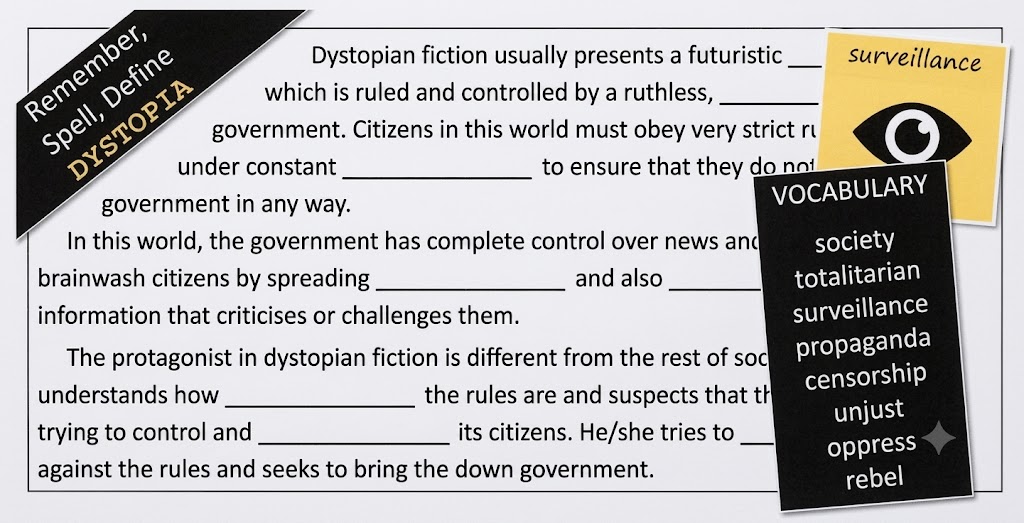
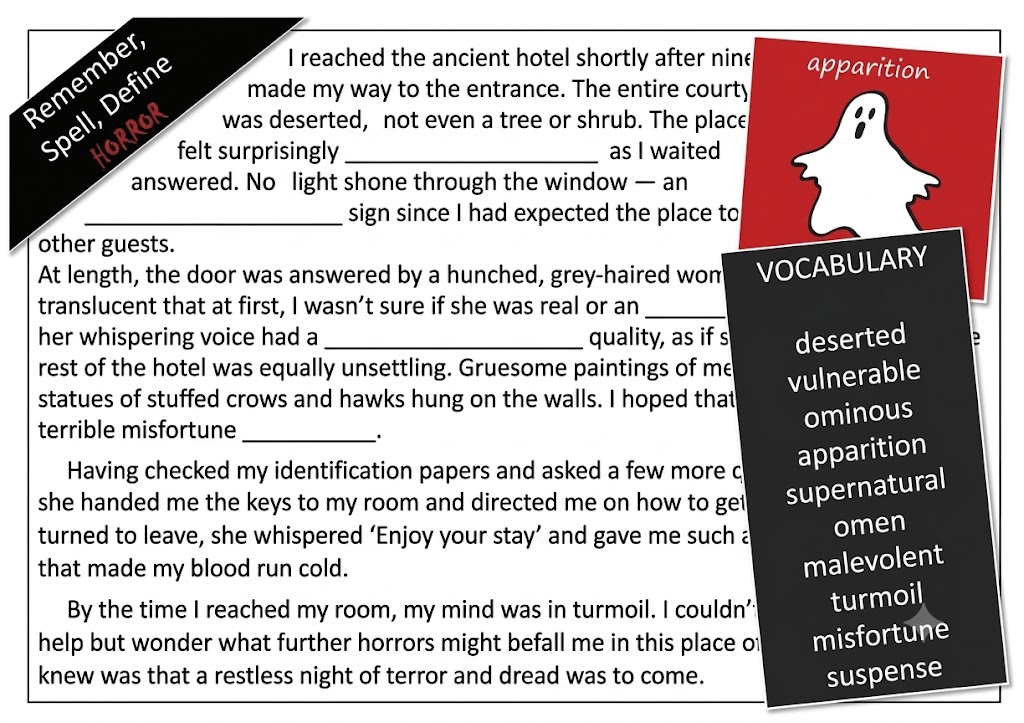
Word lists alone, as we know, will not aid memory and ensure that students retain this vocabulary for long-term use, nor will they teach them to use it confidently within the correct context. An effective strategy to address this is the use of cloze activities which we refer to as ‘Remember, Spell, Define’ (see examples above). Learners are tasked with finding student-friendly definitions for a set of genre-specific words, but the true learning occurs when they are asked to practise using these words, from memory, to complete the sentences in a cloze activity.
Once this knowledge has been consolidated, teachers model the use of the vocabulary, verbally and in writing, and call upon students to do the same when formulating responses to individual texts. It is only through repeated practice that a secure knowledge of this vocabulary is acquired. Dual-coding, the use of image prompts, is a particularly effective way to help students recall their new vocabulary and, while this is important for all learners, as teachers of a large number of EAL students, we have found this method to be especially supportive of those for whom English is not a first language.
‘Where have we seen this before?’
If our objective is for students to use their knowledge of genre as a springboard for making sense of new texts, we must create opportunities for them to explore intertextual connections, and model asking the questions that we want them to pose: Where have we seen this before? How did we respond then? Why has this writer used it now?
Take, for example, Chapter 8 – The Last Night of The Strange Case of Dr. Jekyll and Mr. Hyde, which features a locked door, a dead body, and a series of important but incongruous clues. Students exploring this chapter in isolation are likely to have a different reading experience to those who have read similar extracts from Edgar Allan Poe’s ‘The Murders in the Rue Morgue’, or Arthur Conan Doyle’s The Sign of Four (or, indeed, many of The Adventures of Sherlock Holmes).
Viewed in the context of these latter texts, which precede and follow Stevenson’s novel, the locked door can be recognised as a signpost of the detective genre and, whilst Utterson is not a detective like Dupin or Holmes, it becomes clear that the writer is positioning him – and the reader, by extension – in such a role and tasking them with solving the mystery at this climactic moment. Such recurring signposts serve as points of reference, not only signalling the genre of the writing, but also prompting the reader to consider why the writer has employed such methods and how it shapes their response. As such, by fostering moments when students can explore intertextual links, ask questions of their prior learning, and use it to make new connections, we explicitly model the implicit strategies we want them to develop.
Text transformations
We know that for students to fully appreciate how writers craft a text, they too need to be immersed in the writing process. This is not achieved through the analysis of an extract, nor does assessing learners’ knowledge of genre need to be reduced to a PEE paragraph. The explicit teaching of genre can be coupled with text transformation – rewriting an extract from one genre in the style of another – to give students the opportunity to creatively apply the wealth of knowledge that they have acquired.
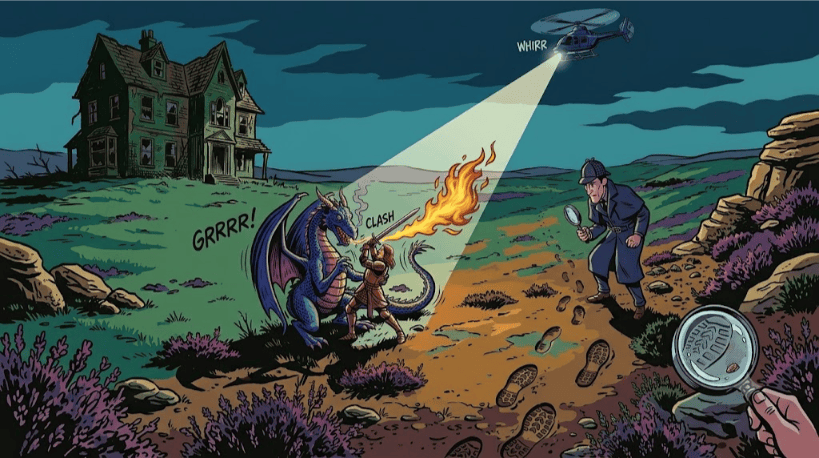
This process can be scaffolded first by looking at book covers: What paratextual clues reveal the genre of the text? How might these differ if the text belonged to another genre? Students looking at the image of fantastical creatures flying through the sky on the cover of a fantasy novel may well suggest that they would be replaced by mechanical surveillance machines on the cover of a dystopia.
The knowledge that students have applied to images is then extended to the transformation of a text. Here, teachers give students an extract which distinctly reflects the conventions of a genre and asks them to convincingly rework these conventions into another. This task offers a range of opportunities for differentiation and challenge. Teachers may choose the transformation extract, or students can be tasked to select their own; similarly, less confident learners could be directed to rewrite the text in a given genre, while more autonomous learners make this decision independently. In this way, students learn to fully exploit their knowledge of genre by creating the signposts that readers (themselves included) look for when making sense of a text.
Food for thought
Increasing student readership is an ongoing aim for all English teachers, one that does not have an easy solution. While there are a number of ideas suggested for addressing this, from daily time slots dedicated exclusively to ‘reading for pleasure’ to electronic quizzing programmes which reward reading stamina, there can be no compensation for knowledge. The understanding students acquire when learning about genre can be transformative and, most importantly, hugely enjoyable for this very reason. By explicitly and implicitly teaching literary genre, we can empower learners with knowledge and – to return to the analogy of the diner – ultimately guide them to sample confidently from the varied buffet of literature available to them.
References
- Bawarshi, A. S. (2003) Genre and the Invention of the Writer. Utah: Utah State University Press.
- Clark, C. and Teravainen-Goff, A. (2020) Children and young people’s reading in 2019 Findings from our Annual Literacy Survey, at: Literacy Trust
- Collins, W. (1999) The Woman in White. London: Penguin Books Ltd.
- Didau, D. and de Bruyckere, P. (2017) ‘Learning Myths’ in Hendrick, C. and Macpherson, R. (ed.) What Does This Look Like in the Classroom? Bridging the Gap Between Research and Practice. Woodbridge: John Catt Educational Ltd.