This article was originally published in NATE’s (National Association for the Teaching of English) publication Teaching English: Issue 32.
Using literature as a springboard for teaching critical literacy
In the age of ‘fake news’, critical literacy is vital, and can be developed through critical-creative approaches to literary texts that students are already studying.
Someone had blunder’d
Episode 5 of the documentary series Frozen Planet depicts a dramatic showdown between two beasts of the Canadian wilderness: wolves and bison. In language loaded with military imagery, David Attenborough invites the audience to observe the battle. The wolves launch an ‘ambush’, rapidly ‘closing in’ on the ‘armed and dangerous’ bison, who form a ‘defensive circle’, knowing that they are ‘safe, as long as they stick together’. The wolves, we are told, just need one bison to break rank and this (spoiler alert) is precisely what follows. A panicked rampage ensues, during which a yearling falls behind and is quickly set upon by opportunistic wolves. Just when its chance of survival couldn’t look more bleak, it is spectacularly mowed down by a larger bison racing to safety, who quite literally knocks the yearling off its feet, and into the waiting jaws of its predators.
Despite the obvious blunder, which results in the death of one of the most vulnerable members of the herd, the language of the commentary has been crafted to focus our attention on the skill of the bison and the way they strategise to hold back a bloody attack. In fact, the clumsy charge of the more senior beast is merely an aside in the greater narration of the herd’s battle. As such, this moment perfectly and, perhaps, unexpectedly encapsulates how language can be adapted to shape an audience’s or reader’s perception of an event.
We couldn’t help but draw parallels with Alfred Lord Tennyson’s ‘The Charge of the Light Brigade’ while watching this episode, and wonder what creative opportunities it could present for conversations around critical literacy. Indeed, the poem already offers teachers fertile ground for such discussions. Any teaching of the wider context of the poem is likely to make reference to The Times article that first reported on the Battle of Balaclava, commending the unflinching courage of the British soldiers, while also recording that they were ‘simply pounded by shot [and] shell’ (Russell, 1854). A reading of this account which acknowledges that the ‘disaster’ was a result of ‘some hideous blunder’ necessarily encourages students to compare the two depictions (newspaper and narrative poem) and question how the event came to be immortalised as the patriotic celebration presented in Tennyson’s text. Moreover, insight into Tennyson’s role as Poet Laureate gives students scope to interrogate his purpose for composing the poem, and the influence this biased account would have had on wider public understanding of the battle.
The showdown between the wolves and bison, then, gives students a chance to further extend these critical literacy skills by applying the knowledge that they have garnered through their reading of the poem. It can be used as an engaging stimulus for students’ own biased writing where they, like Tennyson, use language to carefully position the reader to view the defeated as morally heroic, rather than questioning the mistake that led to their demise. We might ask our students: Imagine if we wanted to present the bison as honourable and valiant, rather than blundering—how might we do it? What does this poem teach us about the way language can be exploited to direct how readers think about an event? And, most importantly, Why might we want to skew their perception in this way?
Stories as Springboards
Understandably, when striving to develop a lean curriculum and facing time constraints, teachers themselves may ask: Why do this? What purpose does a nature documentary serve in a lesson about a 19th century poem? Why begin a conversation around critical literacy when studying literature? And if studying critical literacy, why not opt for the more traditional exploration of newspaper articles?
Firstly, as Daniel Willingham (2004) has asserted when outlining ‘The Privileged Status of Story’, ‘People find material presented in a story format [as we do in literature] more engaging than if it is presented in expository text no matter what the topic.’
Moreover, we could argue that critical literacy is not the reserve of non-fiction schemes of work, nor should it be compartmentalised as a skill that is only pertinent when engaging with journalism. After all, the Economist Educational Foundation (cited by The National Literacy Trust) suggests that ‘it’s important to embed the teaching of critical thinking skills throughout the curriculum rather than trying to ‘tack on’ critical news literacy as something new’ (Fake News and Critical Literacy, 2018). Indeed, we encounter biased language in many places: that could, of course, be a newspaper or news app – but equally it could be a poetry anthology, or even a wildlife documentary on a Sunday evening, which – by its very nature – we assume to be objective and factually accurate.
Rather than being the opposite of critical literacy, literary texts in fact offer us springboards for discussing bias, perspective, and purpose in real-life contexts. Willingham (2004) draws this parallel too, explaining that ‘understanding the actions and characters in a story calls on the same processes we use in trying to understand the actions and intentions of people in the real world.’
So why not harness these moments in literature that could enable our students to make greater connections with – and sense of – the ways they encounter language in their lives? After all, if learning through stories is both engaging and memorable, using literature as a vehicle for exploring critical literacy can only add to the richness of our discussions. What’s more, by teaching critical literacy in different contexts, we can equip students with the knowledge to scrutinise language in many contexts, both fictional and real, and to recognise the powerful potential of words, in a range of forms.
Here we outline some strategies that could help teachers combine critical literacy discourse with the stories that are already shared in their classrooms.
Powerful Language
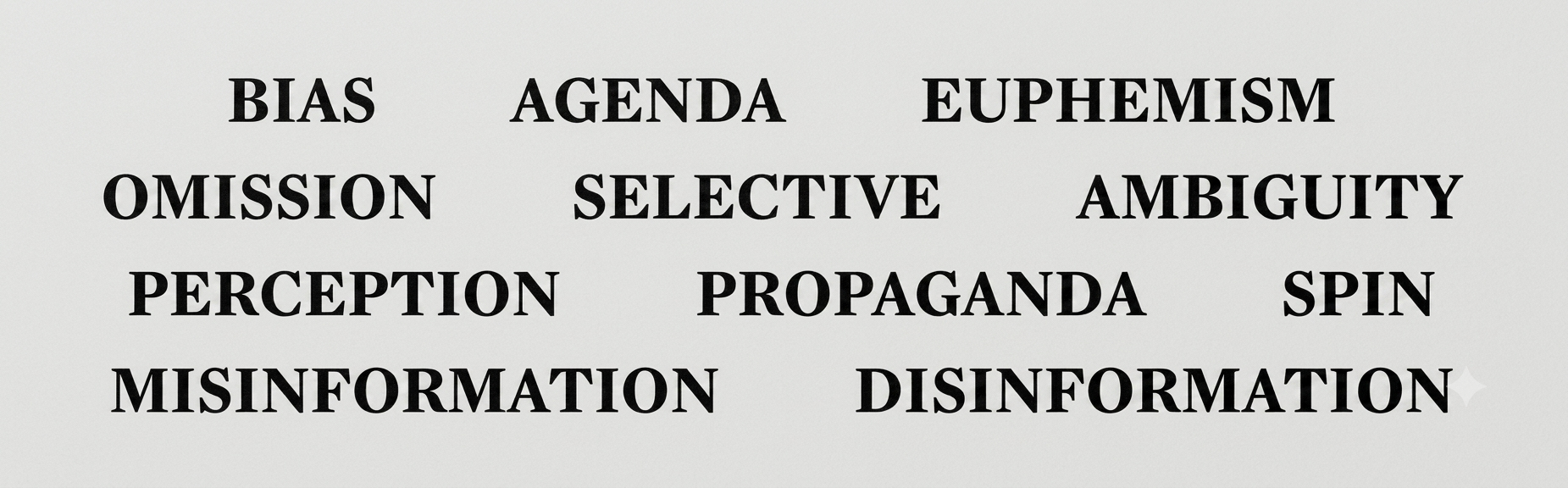
If language is power, we need to begin by exposing students to the words that will enable them to articulate their thinking effectively. A good starting point is to provide them with the vocabulary and concepts that they will need to examine the purpose of a text. While not exhaustive, this bank of subject specific terminology will give them a foundation of knowledge upon which they can confidently build their critical analysis skills.
The teaching of such vocabulary serves two purposes: it gives students precise language to explain writers’ intentions, and the methods they have employed to achieve them, while also giving them insight into some of techniques that they can use to shape their own readers’ responses. The next logical step, then, is to plan for situations where students can become conscious producers of biased texts using these very methods.
Creators, not just consumers
Developing students’ critical literacy through writing is identified as a key priority in the National Literacy Trust’s commission on the subject. Its 2018 Fake News and Critical Literacy report suggests that in order to ‘foster the confidence and skills of young people,’ we ought to be ‘empowering them to become creators, curators and communicators of news – not just consumers of it’. The word ‘creators’ is particularly significant here because it reminds us that critical analysis need not be limited to essay-style exploration; the very act of creative writing can itself be analytical. By ‘involving children in the production of news,’ the report suggests, we can create ‘an efficient way to teach these skills effectively’ because we are giving them a ‘behind-the-scenes’ experience of the thinking, planning and execution of biased writing.
And when devising activities where students can create news, we can begin by considering what opportunities are presented by the stories that are already embedded within our curricula.
1. Animal Farm
Inevitably, dystopian texts lend themselves particularly well to discussions around the way language can be manipulated to serve a specific purpose. Since propaganda, misinformation and disinformation are such fundamental tropes of many dystopian worlds, they offer an opening for students to critically analyse and create. Take, for example, this extract from Chapter 4 of Animal Farm, which serves as a prelude to the Battle of the Cowshed:
Every day Snowball and Napoleon sent out flights of pigeons whose instructions were to mingle with the animals on neighbouring farms, tell them the story of the Rebellion, and teach them the tune of Beasts of England. […] [The humans] put it about that the animals on the Manor Farm […] were perpetually fighting among themselves and were also rapidly starving to death. […] It was given out that the animals there practised cannibalism, tortured one another with red-hot horseshoes, and had their females in common.
A fitting question to pose at this point in the novel would be “Which side – animal or human – is telling the truth?” Many students will tend to assume that the farmers (given the ludicrous nature of their gossip) are dishonest, but if we probe further, they begin to understand that the animals are also evading the truth. After all, the pigs have already taught themselves to read and write, commandeered the apples and milk, and excluded themselves from the manual labour of the farm by Chapter 3, and are therefore already undermining the values of the Rebellion. A further question to then pose would be “Which version of disinformation – animal or human – is most dangerous? Why is that?”
Using this premise of disinformation, students can then be tasked with recounting the Battle of the Cowshed, either for an animal or human news report, by purposefully creating a biased account that skews their readers’ perception of the event. To do this, teachers could:
- Create witness statements or interviews from which students artfully select and omit evidence based on their intentions and motives
- Plan opportunities for students to unpick euphemisms in the novel so far, and experiment with using them in their own writing: What euphemistic language could we use to make Boxer kicking the stable lad or Farmer Jones shooting Snowball more palatable for the reader?
- Provide students with photographs for which they need to write headlines that influence how readers view them: How could both the animal and human sides skilfully create a headline that spins the reader’s understanding of a single image?
- Create vocabulary lists from which students evaluate and choose the language for their headlines: How could we make our bias subtle and therefore more insidious, rather than overtly hyperbolic (and therefore, unconvincing)?
2. Reality Check
Taking on the role of writers and journalists is an important aspect of students understanding the complex process of news production, but planning a scheme of work that explores the use of biased language in a particular news form – traditionally, tabloid versus broadsheet newspapers – can be limited. It cannot address all the ways in which news is consumed, especially by young people, many of whom access current affairs through social and digital media.
Teachers may not be able to plan for all these ever-evolving forms; however, we can ensure that we plan for conversations that guide our learners to evaluate the reliability of the news forms they choose. Investigations based on fake news, misinformation and disinformation (with a deliberate focus on intention) are key, if we are to equip students with the skills to interrogate their own news sources independently. This needs to include questions around why fake news is able to exist, and what measures are being taken to counteract its influence.
An interesting example is the BBC’s Reality Check feature. Established in 2017, it has been described by The Guardian as a means of targeting ‘false stories or facts being shared on social media’, aiming to ‘debunk deliberately misleading narratives that are ‘masquerading as real news’ (Jackson, 2017). Drawing students’ attention to reporting of this kind alerts them to the prevalence of unreliable information presented as news, and can be used to shape discussions about the imprecise nature of what is said and the misleading impact of what is omitted in some of the stories to which we are exposed.
Reality Checks usually take a claim made by a public figure, research body, or organisation, and outline the date and context of what has been said, before breaking down the statement by closely examining the language used, and its intention. In this way, they offer a useful analytical framework for scrutinising the words of real-life and fictional figures. Indeed, literature presents us with many characters who use language to influence, manipulate and mislead. Building in Reality Check pitstops when studying literature texts means that we can invite our students to deconstruct how characters try to realise their agenda, in the same way that we might probe the language and intention of a real-life figure.
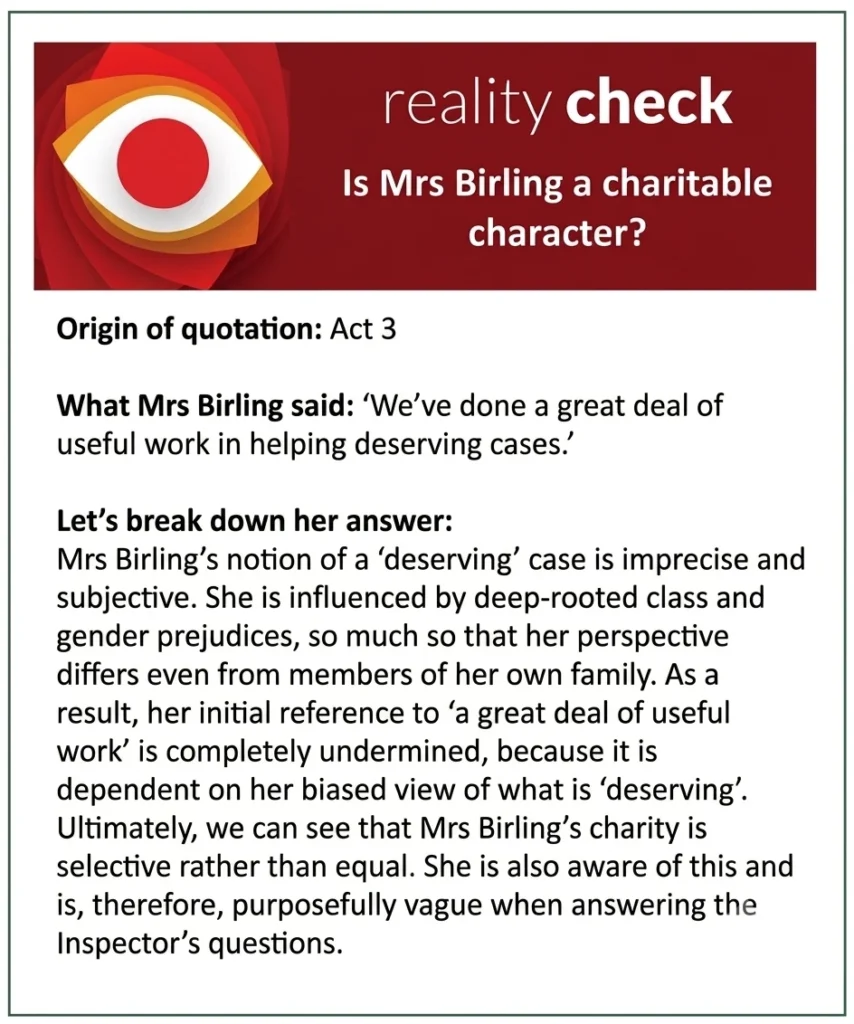
Take, for instance, this example from An Inspector Calls. The critical literacy vocabulary we alluded to earlier offers a valuable tool for analysing Mrs Birling’s words and the way she carefully promotes her charitable enterprise, while subtly suggesting that Eva was not worthy of it. When modelling such a Reality Check analysis some questions to pose could include ‘What is the character’s agenda at this point? How do their vocabulary choices help achieve this? What information is vague? What information has been deliberately omitted? What is the impact?’
A further activity, linking these skills back to students’ everyday experience of news would be to task them with creating a Reality Check for a claim that they have recently encountered through their own news consumption, be it from a politician, sports personality, celebrity or influencer. Additional challenge could also be added by asking students to select a claim that uses the same methods to skew the truth as the character they have been studying in the current literature text.
Recognising Constructs
If critical literacy is to be embedded into the curriculum in an engaging and relevant way, this back and forth between fiction and non-fiction is key. A strength of so many English departments and their curriculum maps is the way the study of literature is framed as the study of the human condition. Helping students to understand that the behaviours and experiences of characters are not dissimilar to those which humans encounter in the real world means, as suggested earlier, that literature can be used as a lens for making sense of the events and experiences reported in our news.
In order to support students with tracing the ideas that they are exposed to in poetry, prose and drama, across the news stories they see in the real world, we need to first model making these links and asking the questions we want them to pose. A useful way to do this is to track a character type, theme or event across a series of texts and forms.
For example, Shakespeare’s Othello and Mohsin Hamid’s The Reluctant Fundamentalist both present us with protagonists across time and place who are exoticised and reduced to stereotypes, but who also respond to their ‘othering’ in very different ways. Where can we see public figures similarly represented in our media? What are the parallels in the ways such characters are created, in fiction and non-fiction? When are we being positioned to view such characterisations as positive and when are we encouraged to regard them as negative? Why?
Themes and events can also be tracked in a similar way. Hysteria in a text like The Crucible could be simply dismissed as thriving on the ignorance and isolation of a Puritan community, but when linked to very modern and familiar examples such as the 2016 fear of killer clowns, students can begin to critically analyse how easily such hysteria is created. What methods are used to incite panic in both these fiction and non-fiction accounts? What is the purpose of creating such hysteria? Why are we so susceptible to its effects?
Similarly, a close analysis of the misinformation and sensationalist news reporting presented in novels such as The War of the Worlds can be coupled with finding alarmist echoes in the news our students access through different platforms (albeit not Martian-related).
While tracing these parallels across fiction and non-fiction enables students to recognise the real-life relevance of the texts they are studying, perhaps the most valuable aspect of such tasks is that they encourage them to view all stories as constructs and therefore ask more critical questions about their methods and motivations.
A ready-made starting point?
The changing ways in which students consume news have made it necessary for us to ensure that they are equipped with the critical literacy tools to question and challenge what they are told. An important point of reflection for teachers and departments would be to consider whether this requires new sequences of lessons, or indeed new schemes of learning. In fact, what we have found is that some of the most valuable resources already exist within our curricula, offering an authentic and engaging way to develop critical literacy skills through the richness of storytelling.
References
- Jackson, J. (2017). ‘BBC sets up team to debunk fake news’. The Guardian, 12 January.
- Russell, W. H. (1854). ‘London, Monday, November 13, 1854’. Editorial in The Times, 13 May. (Available at the British Library website).
- The National Literacy Trust. (2018). Fake news and critical literacy. (Available at the NLT website).
- Willingham, D. (2004). ‘The Privileged Status of Story’. American Educator [online], 28(2). (Available from the American Educator website).